


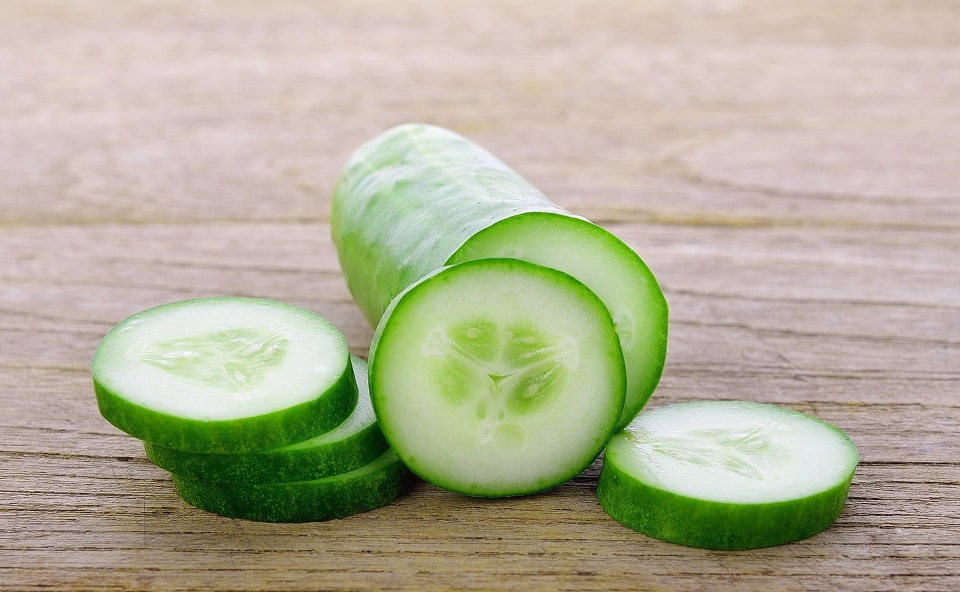
Cucumber is a generally developed sneaking plant in the Cucurbitaceae family that normally has round and hollow natural products, which are utilized as vegetables. Treated as a yearly plant, there are three primary assortments of cucumber – cutting, pickling, and burpless/seedless – inside which numerous cultivars have been made. The cucumber begins from South Asia, however presently develops on most mainlands, as various kinds of cucumbers are exchanged the worldwide market. In North America, the term wild cucumber alludes to plants in Echinocystis and Marah, albeit the two are not firmly related. For more information visit whybenefit.
Portrayal
Cucumber is a crawling creeper that flourishes in the ground and grows up a lattice or other supporting casing by folding over the help with slight, twisting ringlets. The plant can likewise flourish in a soilless medium, permitting it to spread along the ground rather than a supporting design. The plant has enormous leaves that structure an overhang over the natural product.
The product of explicit assortments of cucumber is generally round and hollow however with tightened closes, and can be pretty much as extensive as 62 cm (24 in) long and 10 cm (4 in) in width.
Cucumber natural products contain 95% water (see nourishment table). In plant terms, the cucumber is delegated a pepo, a kind of vegetable berry with a hard external skin and no inside divisions. Be that as it may, similar to tomatoes and squash, it is much of the time treated, ready and eaten as a vegetable.
Blossoms and fertilization
Most assortments of cucumbers are cultivated and require fertilization. For this reason, a great many honey bees yearly take to cucumber fields not long before they sprout. Cucumbers can likewise be pollinated through honey bees and numerous other honey bee species. Most cucumbers that require fertilization are self-contradictory, subsequently requiring one more plant’s dust to shape seeds and organic product. A couple of self-viable cultivars exist that are connected with the ‘Lemon’ cultivar.
A few cultivars of cucumber are parthenocarpic, whose blossoms produce seedless organic product without fertilization, which diminishes the palatable nature of these assortments. In the United States, these are usually filled in nurseries, where the honey bees are kept outside. In Europe, they are filled outside in certain areas, where honey bees are likewise kept outside.
Customary assortments produce male blossoms first, then, at that point, female, generally equivalent numbers. The fresher gynoecious mixture assortments produce practically all female blossoms. A pollinator cultivar might be planted close to them, and the quantity of honey bees per unit region increments, yet temperature changes prompt male blossoms on these plants also, which might be adequate for fertilization. Also, checkout the Beneftis of cucumber water.
Sustenance, fragrance and taste
Crude cucumber (with strip) is 95% water, 4% sugar, 1% protein, and has irrelevant fat. A 100 gram reference serving gives 67 kilojoules (16 kilocalories) of food energy. It contains a low measure of micronutrients: it is prominent just for vitamin K at 16% of the day to day esteem (table).
Contingent upon the assortment, cucumbers can have a gentle melon smell and taste, coming about because of unsaturated aldehydes, for example, (E,Z)- nona-2,6-diinal, and cis-and 2-nonenal K. Trans-isomer. The somewhat unpleasant taste of cucumber strip is expected to cucurbitacin.
Cutting
Cucumbers developed for crisp eating are called cutting cucumbers. The principal assortments of slicer mature on plants with enormous leaves that give concealing.
Financially developed slicers for the North American market are by and large longer, smoother, more uniform in variety, and have a harder skin. Interestingly, in different nations, cucumbers, frequently called European cucumbers, are more modest and have a more slender, more sensitive skin, frequently less seeds, in this manner frequently sold in plastic skin for security. This assortment may likewise be called transmit cucumber, particularly in Australia.
Pickling
Pickling with salt, sugar, vinegar and flavors makes an assortment of enhanced items from cucumbers and different food varieties. Albeit any cucumber pickle can be made, business pickles are produced using cucumbers uncommonly reared for consistency of length-to-breadth proportion and absence of dispersing in the tissue. Cucumbers made for pickling, called pickles, develop to be around 7 to 10 cm (3 to 4 in) long and 2.5 cm (1 in) wide. Contrasted with slicers, picklers are more modest, thicker, less-standard in shape, and have rough skin with short white or dark spotted spines. Variety can differ from rich yellow to light or dim green.
Cucumber
Gherkins, likewise called cornichons or child pickles, are little cucumbers, generally 2.5 to 12.5 cm (1 to 5 in) long, frequently with a rough skin, normally utilized for pickling. are finished. The word gherkin comes from the Early Modern Dutch gürken or augerken (‘little salted cucumber’). The term is likewise used to name Cucumis anguria, the West Indian gherkin, a firmly related animal varieties.