
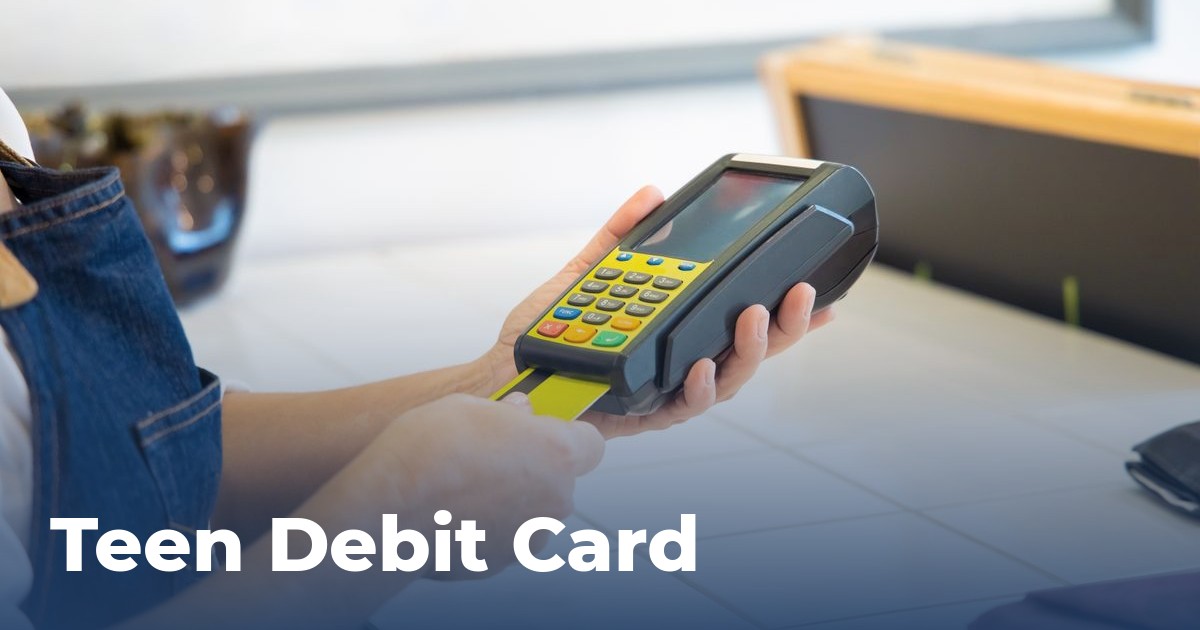
Your teenager wants a debit card. Maybe they have a part-time job, an allowance, or birthday money burning a hole in their pocket — and cash feels old-fashioned to them. A teen debit card sounds like the obvious answer: a real card, in their name, that lets them spend their own money while you watch every transaction from your phone. But a teen debit card is not quite the same as the debit card in your wallet, and the differences matter. Some are real bank accounts, some are prepaid cards run by an app, and the fees range from free to about $20 a month.
This guide explains teen debit cards as they actually work in 2026: what they are, how the parental controls work, the best options and what each one costs, and how to pick the right one for your teenager. It is general educational information only, not personal financial advice. The prices and features below come from the providers’ own published pricing and from independent comparisons by Finder, CreditDonkey, and MyMillennialGuide, all updated in November 2026.
What Is a Teen Debit Card?
A teen debit card is a payment card issued to a child or teenager — usually aged 6 to 17 — that lets them spend money from an account a parent controls. The teenager gets a card with their name on it and an app that shows their balance. The parent gets the controls: spending limits, alerts for every purchase, the ability to block certain stores or categories, and the power to add money or freeze the card instantly. The teenager cannot spend more than the balance, and in most cases cannot go into overdraft at all.
The important detail is who actually owns the account. A person under 18 cannot open a bank account alone in the United States. With a teen debit card, the parent is the account owner or co-owner, and the teenager is an authorised user. That is true whether the product is a real bank account, like Chase First Banking, or a fintech product, like Greenlight or Acorns Early. The distinction matters because it decides what happens to the money, what protections apply, and what the card turns into when the teenager turns 18.
There are two kinds of teen debit card, and they are easy to confuse. The first kind is a real checking account at a bank, opened jointly by a parent and a teenager — Chase First Banking and Chase High School Checking are the best-known examples. The money sits in an FDIC-insured bank account, the teenager gets a debit card linked to it, and the account can eventually become a regular adult checking account. The second kind is a prepaid card from a financial technology company — Greenlight, Acorns Early, Current, and Step all work this way. The company is not a bank; it partners with a bank that holds the funds, and the card draws from a prepaid balance rather than a checking account. Both kinds work at shops and ATMs, but only the bank-account kind is a stepping stone to a full adult account.
Either way, the money on a teen debit card is the teenager’s spending money, not a loan. A debit card spends money that is already there. If the balance is $40, the teenager can spend $40 and no more. There is no interest, no monthly bill, and — unlike a credit card — no debt to repay. That is the whole point: a teen debit card teaches spending with real limits, in a system where the worst mistake costs the balance on the card and nothing more.
How Do Teen Debit Cards Work?
The setup is the same on almost every product. A parent downloads the app, verifies their identity, links their own bank account or debit card as the funding source, and creates a profile for the teenager. The teenager gets a physical debit card in the post — usually within a week — and access to a simpler version of the app that shows their balance, their transactions, and any savings goals they have set. The parent’s version of the app has all the controls.
Funding is flexible. Parents can transfer money instantly from their own account, set up a recurring allowance — say $20 every Friday — or pay for completed chores automatically. Some apps let grandparents or other relatives send money to the teenager’s card too. The teenager can then spend the money in shops, online, or at an ATM, up to the limits the parent sets. Every transaction triggers an instant notification to the parent’s phone, showing where the money went and how much is left.
The parental controls are the real product, and they are more detailed than most parents expect. On Greenlight, for example, a parent can set spending limits by store or by category — so the card works at the grocery shop but not at a gaming site — block ATM withdrawals entirely, and require approval before the teenager can buy a stock. On Chase First Banking, a parent can set spending limits, watch transactions in real time, and assign chores with a payment attached. On Acorns Early, the controls come with short financial literacy lessons built into the app, so the teenager learns why the limit exists rather than just hitting it.
What happens when the teenager turns 18 depends on the product. A Chase High School Checking account converts to a regular Chase Total Checking account when the teenager turns 19, with the parent removed. A Greenlight or Acorns Early account simply ends — the teenager needs to open their own adult account, which is a good moment to sit down together and choose one. Our guide to checking account benefits explains what to look for in that first adult account, and our guide to how to start building credit covers the next step after a debit card: a credit history.
The Best Teen Debit Cards in 2026
There is no single best teen debit card, because the right choice depends on what you want the card to do. The five products below are the ones that appear at the top of every independent comparison in 2026, and each one is best at something different. Prices are the providers’ published 2026 pricing.
Greenlight is the most complete option and the best choice if you want the strongest parental controls. The Core plan costs $5.99 a month and covers up to five children, with chores, allowance automation, spending limits by store and category, and real-time alerts. The Max plan costs $9.98 a month and adds an investing platform — teenagers can buy stocks and ETFs from $1, with a parent approving every trade — plus cashback and identity protection. Higher tiers, Infinity at $15.98 and Family Shield at $19.98 a month, add more protection features. There is no minimum age, and a 30-day free trial lets a family test it before paying. Greenlight is not a bank; banking services are provided by Community Federal Savings Bank, Member FDIC.
Acorns Early — formerly GoHenry — is the best choice for younger children and for families that want the money lessons built in. It serves ages 6 to 18, and its Lite plan costs $8 a month for up to four debit cards, with a Gold plan at $12 a month adding family financial wellness tools. The app turns allowance, chores, and savings goals into a game, with short money lessons the child completes to earn rewards. The card is issued by a partner bank, Member FDIC. It is a strong pick for a 6- to 12-year-old; teenagers may find its controls and limits too simple.
Chase First Banking is the best free option, with one condition: the parent must already have a Chase checking account. It is free — no monthly fee, no reload fee — for children aged 6 to 17, with parental controls, spending limits, chores, and savings goals, plus access to Chase ATMs and branches across the country. Daily limits are $400 for purchases and $100 for ATM withdrawals. The account is powered by Greenlight’s technology, so the controls feel familiar, but the money sits in a real Chase account. For a teenager aged 13 to 17, Chase also offers High School Checking: a free joint checking account with a parent as co-owner, which converts to a regular Total Checking account at age 19.
Current Teen Banking is the best free option for older teenagers who do not bank at Chase. It is free, built for ages 13 and over, and offers higher spending limits — up to $2,000 a day — plus automatic allowances, instant transfers, savings goals, round-ups that sweep spare change into savings, and charitable giving tools. Current is a financial technology company, not a bank; banking services are provided by Cross River Bank, Member FDIC.
Step is the best free option for a teenager who is thinking about credit. It is a free Visa card for ages 13 and over, with no monthly fee, no overdraft fees, and no minimum balance — and it is the only teen card on this list with a credit-building feature, reporting the teenager’s activity so they can start building a credit history before they turn 18. That feature is worth understanding properly before relying on it, so read our guide to how to start building credit alongside it.
What Do Teen Debit Cards Actually Cost?
The headline price is rarely the whole cost, so it helps to do the yearly maths. Greenlight Core at $5.99 a month costs $71.88 a year for the whole family — up to five children, so about $14.38 a year per child in a five-child family, or the full $71.88 for one child. Greenlight Max at $9.98 a month costs $119.76 a year. Acorns Early Lite at $8 a month costs $96 a year, and Gold at $12 a month costs $144 a year. Chase First Banking, Chase High School Checking, Current, and Step all cost $0 a year in monthly fees.
Monthly fees are not the only cost. Some products charge for ATM withdrawals outside their network — Chase charges $3 per withdrawal at a non-Chase ATM in the US and $5 outside the US, for example — and some charge to replace a lost card or to load money in certain ways. Greenlight’s reloads from a linked bank account are free, but loading by debit card has a minimum. Before choosing, check the fee schedule for the three charges that actually bite: ATM fees, card replacement fees, and any fee for instant transfers.
There is also a hidden cost worth naming: a paid card only earns its fee if the family uses the features. A $71.88-a-year Greenlight Core plan is good value for a family that uses chores, allowance automation, and per-store limits every week, and poor value for a family that only tops up the card once a month. A free Chase or Current account costs nothing and still covers the basics — limits, alerts, and savings goals — so for many families it is the better deal. The right question is not “which card is cheapest?” but “which features will we actually use every week?”
A practical way to think about it: a teenager who receives $20 a week in allowance gets $1,040 a year. If they save 20% of it — $4 a week — they end the year with $208 in savings and a habit that matters far more than the card they used to build it. Our guide to saving money on groceries shows the same habit applied to a household budget, and our guide to what a zero-based budget is explains a method a teenager can genuinely use: give every dollar a job before the month begins.
Debit vs Credit: What Your Teen Should Understand
The most important lesson a teen debit card teaches is the difference between spending your own money and borrowing someone else’s. A debit card spends money that is already in the account. A credit card spends the bank’s money, and the bill arrives later with interest if it is not paid in full. Teenagers who only ever use a debit card can reach adulthood without understanding that difference — and the first credit card offer they receive at 18 can be an expensive surprise.
That is why the debit card should come with a conversation, not just an app. Explain that the money on the card is finite: when it is gone, it is gone until the next allowance or paycheque. Explain that a debit card does not build a credit score — with one exception. Step’s credit-building feature is the only product on this list that reports activity to the credit bureaus, and it is a genuine head start. For everything else, the teenager’s credit history starts at 18, and our guide to checking a credit score for free explains how to see the report a lender will see, while our guide to whether a 740 credit score is good explains what the number means once it exists.
Two practical rules make the lesson stick. First, set the spending limit together, not in secret — a teenager who helped choose a $50 weekly limit will respect it far more than one who discovers it at the checkout. Second, let small mistakes happen. A teenager who spends their whole allowance on the first day and has nothing left for the rest of the week has learned a lesson that no lecture can teach, and the cost is a week without spending money rather than a debt that follows them for years. That is exactly what a teen debit card is for: a safe place to make the mistakes that are expensive later.
Parents should also know the fraud protections. Debit cards do not carry the same legal protections as credit cards: if someone steals a debit card number and drains the account, the money is gone until the bank investigates, and the liability rules are stricter than for credit cards. That is a reason to keep the card balance modest, to turn on transaction alerts, and to teach the teenager never to share the card number, the PIN, or the app password — and never to use the card on a website they do not trust.
How to Choose the Right Card for Your Teen
Start with your bank. If you already have a Chase checking account, Chase First Banking or High School Checking costs nothing, sits inside the banking relationship you already have, and gives your teenager a real account that grows into an adult one. If you bank elsewhere, check whether your own bank offers a joint teen account first — many do, and the simplest option is usually the best one.
If your bank does not offer one, decide what you actually need. If the priority is control — chores, allowances, per-store limits, approving every stock trade — Greenlight is the most complete tool and the $5.99 Core plan is the one most families need. If the priority is teaching, and your child is under 13, Acorns Early’s lessons and game-like design fit better. If the priority is a free card for an older teenager, Current or Step are the strongest choices, with Step winning if credit building matters to you.
Then set it up as a teaching tool, not just a payment method. Agree on an allowance and a payday. Agree on one savings goal — a game, a bike, a concert ticket — and set up an automatic transfer so a slice of every allowance goes to it before spending starts. Agree on the spending limit together, and review the transactions once a week for the first month: not as an interrogation, but as a five-minute conversation about what the money did. The card is the tool; the conversation is the education.
Finally, plan the exit. A teen debit card is a training product, and it should end. When the teenager gets a part-time job, talk about direct deposit into their own account. When they turn 18, help them open an adult checking account and, when they are ready, a secured credit card to start building a credit history. The goal was never the card itself. It was a teenager who arrives at adulthood knowing how to spend within their means, save for something they want, and tell the difference between their money and borrowed money.
Frequently Asked Questions
What age can a teenager get a debit card?
It depends on the product. Greenlight has no minimum age, Acorns Early and Chase First Banking start at age 6, and Step, Current, and Chase High School Checking start at age 13. In every case, a parent or guardian must open and control the account — a person under 18 cannot open a bank account alone in the United States.
Does a teen debit card build credit?
Almost never. A debit card spends the teenager’s own money, so there is no borrowing to report to the credit bureaus, and no credit history is created. Step is the exception: its credit-building feature reports the teenager’s activity, giving them a head start on a credit history before they turn 18. For every other teen card, credit building starts with a first credit card or a secured card after 18.
Are teen debit cards safe?
Yes, with the usual caveats. The funds are held by an FDIC-insured bank or a partner bank, Member FDIC, so the money is insured up to the legal limit if the bank fails. Parents can freeze the card instantly, set spending limits, and see every transaction in real time. The main risk is the same as with any debit card: if the card number is stolen, the money leaves the account immediately, and debit cards carry weaker fraud protections than credit cards — so keep the balance modest and the PIN private.
Can a teenager get a debit card without a parent?
No. Every teen debit card requires a parent or guardian to open the account, verify their identity, and fund it. A teenager under 18 cannot open an account independently, and any product that claims otherwise should be treated with suspicion.
Is Greenlight or Chase First Banking better?
It depends on whether you already bank at Chase. Chase First Banking is free, sits in a real Chase account, and gives the teenager a path to an adult checking account — so if you are a Chase customer, it is the obvious first choice. Greenlight is the better tool if you want the most detailed controls, chores and allowance automation, and an investing platform for your teenager, and you are willing to pay $5.99 a month for it. Many families use Chase for the account and Greenlight’s free trial to test whether the extra controls are worth paying for.
The Bottom Line
A teen debit card is a training tool with a real card attached: it lets a teenager spend their own money, within limits a parent sets, in a system where the worst mistake costs the balance on the card and nothing more. The best free options in 2026 are Chase First Banking for Chase customers, and Current or Step for everyone else — Step if credit building matters. The best paid option is Greenlight Core at $5.99 a month, which buys the most complete set of parental controls and, on the Max plan, an investing platform where a teenager can buy stocks from $1 with a parent approving every trade. Acorns Early is the best fit for younger children, with money lessons built into the app. Whichever card you choose, the card is only half the job: agree the allowance and the limit together, set one savings goal, review the spending once a week, and plan the move to a real adult account at 18. A teenager who has practised with their own money — and made a few small mistakes with it — arrives at adulthood with a skill no app can teach on its own.