


Visitare la Puglia is an experience that will allow you to discover fascinating towns , beautiful villages , olive groves, farms and paradisiacal beaches.
This region in fact boasts 800 kilometers of coastline , 4 UNESCO sites and a thousand-year history that has its roots in the ancient peasant and maritime civilizations of this territory.
Inhabited since prehistoric times, as the numerous dolmens and caves rich in archaeological finds can testify, in the first millennium BC Puglia was the land of the Japigi,a people coming from Illyria divided into 3 tribes: Dauni (in the north), Peuceti and the Massapi in the south who coexisted, not without conflicts, with the Greek inhabitants of colonial cities such as Taras, today’s Taranto.
Subsequently, Puglia became part of the Roman Empire and its history was intertwined with that of southern Italy, with Byzantine, Longobard, Saracen and Swabian dominations and influences.
TodayPuglia is one of the most visited regions in Italy, thanks to its beaches, its architectural beauties and natural parks, such as that of the Gargano.
Apulian cuisine is also appreciated, simple but rich in flavor, where seafood dishes alternate with those of the land, with extra virgin olive oil as a common thread.
Let’s see what to visit in Puglia from Gargano to Salento, passing through Imperial Puglia, Bari and the Itria Valley.
Places to see in Puglia
The Gargano and the Capitanata, the northern part of Puglia
The Gargano is amountainous promontory northof the region and ideally represents the “spur” of the “heel” of the “Italian boot”. Very popular in the summer for its longbeachesand coast full of sea caves , the Gargano offers the most attentive visitors precious cultural and naturalistic sides.
On one side we find theseaside villagesof Vieste , Peschici and Rodi Garganico , on the other side of the perched villages formerly dedicated to the transformation of raw materials from the hilly pastures and fromthe Puglia board, the second largest plain in Italy. In the center is theUmbra Forestwhich with its beech woods has become a Unesco heritage, as well as the Sanctuary of San Michele in Monte Sant’Angelo , a splendid medieval town, a destination for pilgrims such as the nearby San Giovanni Rotondo , city of Padre Pio. Not far from the coasts of the Gargano there is the small archipelago of the Tremiti Islands , a protected marine reserve.
The Dauni mountains with their characteristic fortified villages mark the border of Puglia with Campania and Molise. Very interesting are the traditions and religious festivals, such as the Festa del Soccorso in San Severo and the Dauno carnival in Manfredonia.
Imperial Puglia
This part of Puglia is named after the traces left by the EmperorFrederick II, starting with Castel del Monte , one of the symbolic places of the region,a Unesco site.
In addition to the Castle, on an isolated hill, the village of Trani is very interesting , with the Swabian Castle and the Cathedral on the sea,Barlettawith its colossus and its castle, Canosa with its archaeological finds and Margherita di Savoia, where you will await a surreal landscape crossing thin strips of land surrounded by water, sea and salt flats.
Bari, the Murge, the Cathedrals and the Itria Valley
The central part of Puglia is full of points of interest, starting from the greatRomanesque cathedralssuch as those of Bitonto, Altamura and obviously the basilica of San Nicola in the heart of old Bari, up to the white agricultural villages of the Itria Valley such as Ostuni, Locorotondo, Martina Franca and Cisternino, passing through the beautiful seaside villages such asMonopoli and Polignano a Mare.
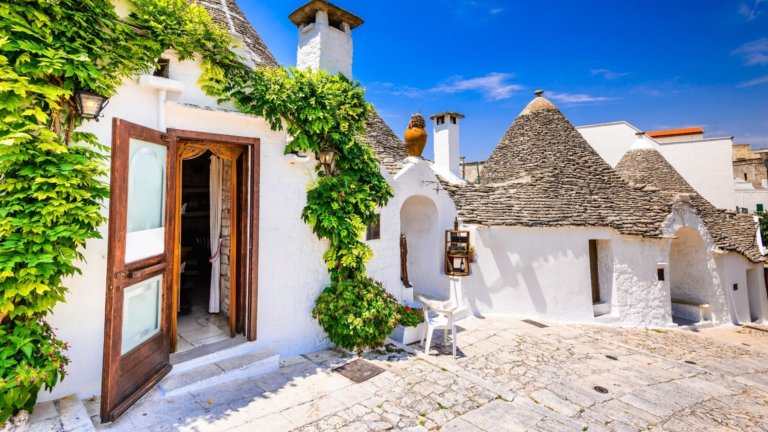
Among the main destinations are the Unesco site Alberobello, which owes its fame above all to the ancient rural buildings called trulli.
In addition to the center of Alberobello, the trulli are present in all the countryside of the Itria valley, which with the olive groves, the typical dry stone walls and the white perched villages give us spectacular landscapes and unique landscapes.
Other attractions are the Fasano safari zoo with the adjoining Fasanolandia amusement park and theCastellana caves, a spectacular complex of underground cavities of karst origin, therock architectureof Gravina and nearby Matera (in basilicata) as well as of course the Mediterranean landscapes of Polignano a Mare, Monopoli and Giovinazzo.